For those interested in the conceptual underpinnings of my work.
My understanding of learning is informed by several theoretical traditions that I bring together through research and practice. Rather than working within a single framework, I use this combination as a conceptual lens for making sense of how learning unfolds across contexts and over time.
This lens helps me connect research, design decisions, and lived learning experiences, particularly where questions of agency, responsibility, and technology intersect.
Learning as Regulation Integrated Over Time
Learning does not occur in a single moment or setting. It unfolds across activities, relationships, and contexts, and is carried forward over time by the learner (de Barba, 2017).
The diagram below represents how regulation is distributed within activities, while integration happens across time.
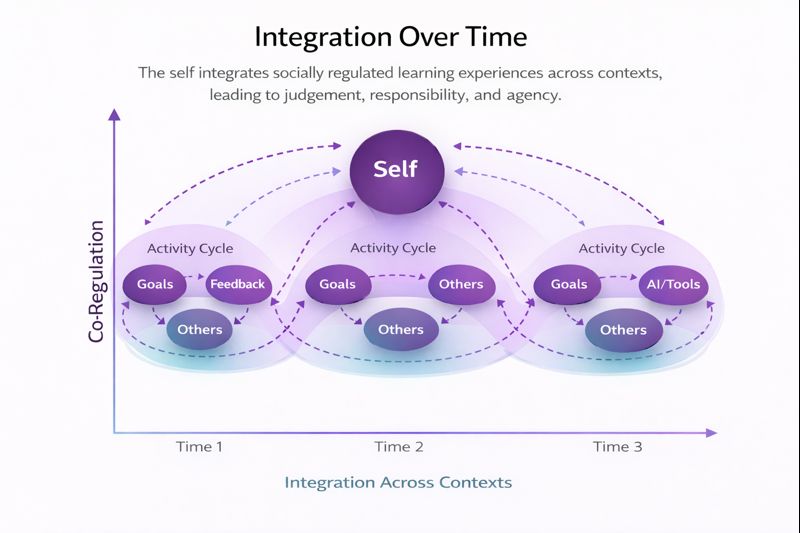
Within any learning activity, regulation is often co-regulated (Hadwin, Järvelä, & Miller, 2011; Singh & Muis, 2024; Winne & Hadwin, 1998):
- goals are negotiated
- standards are made visible
- monitoring and evaluation are supported
- decisions are shared with others or tools
This activity-level regulation is relational and situated. It reflects how learners participate in learning with others, rather than in isolation.
Across activities, however, something else is happening.
The learner integrates these experiences over time. Through reflection, evaluation, and responsibility-taking, regulatory processes are increasingly taken up by the self — the organising centre that carries learning across contexts and time (Boekaerts & Niemivirta, 2000).
From this perspective:
- co-regulation and self-regulation are not opposites
- regulation can be shared without dissolving agency
- responsibility is gradually internalised, not removed
In the image above, the vertical axis represents co-regulation, which is present throughout learning activities. The horizontal axis represents time, across which learning experiences accumulate. What changes is not whether regulation is relational, but how learning is integrated by the learner over time and across contexts (King, Perez & Barber, 2023).
This view helps reconcile individual and social accounts of self-regulated learning. Regulation may be distributed across people and tools in the moment, but learning is integrated by the self across time — supporting continuity, agency, and becoming.
Learning may be distributed across people and tools,
but agency and responsibility remain with the learner,
who gives learning meaning by integrating experience
over time and across contexts.
References
Boekaerts, M., & Niemivirta, M. (2000). Self-regulated learning: Finding a balance between learning goals and ego-protective goals. In Handbook of self-regulation (pp. 417-450). Academic Press.
de Barba, P. G. (2017). Autonomous learning and achievement motivation in online learning environments (Doctoral dissertation, PhD thesis, The University of Melbourne, Australia).
Hadwin, A. F., Järvelä, S., & Miller, M. (2011). Self-regulated, co-regulated, and socially shared regulation of learning. Handbook of self-regulation of learning and performance, 30, 65-84.
King, P. M., Perez, R. J., & Barber, J. P. (2023). Variability patterns in self-authorship trajectories: Complicating understanding of development. The Review of Higher Education, 47(1), 1-30.
Singh, C. A., & Muis, K. R. (2024). An integrated model of socially shared regulation of learning: The role of metacognition, affect, and motivation. Educational Psychologist, 59(3), 177-194.
Winne, P. H., & Hadwin, A. F. (1998). Studying as self-regulated learning. In D. J. Hacker, J. Dunlosky, & A. Graesser (Eds.), Metacognition in educational theory and practice (pp. 277-304). Hillsdale, NJ: Lawrence Erlba
 Paula Galvão de Barba, PhD