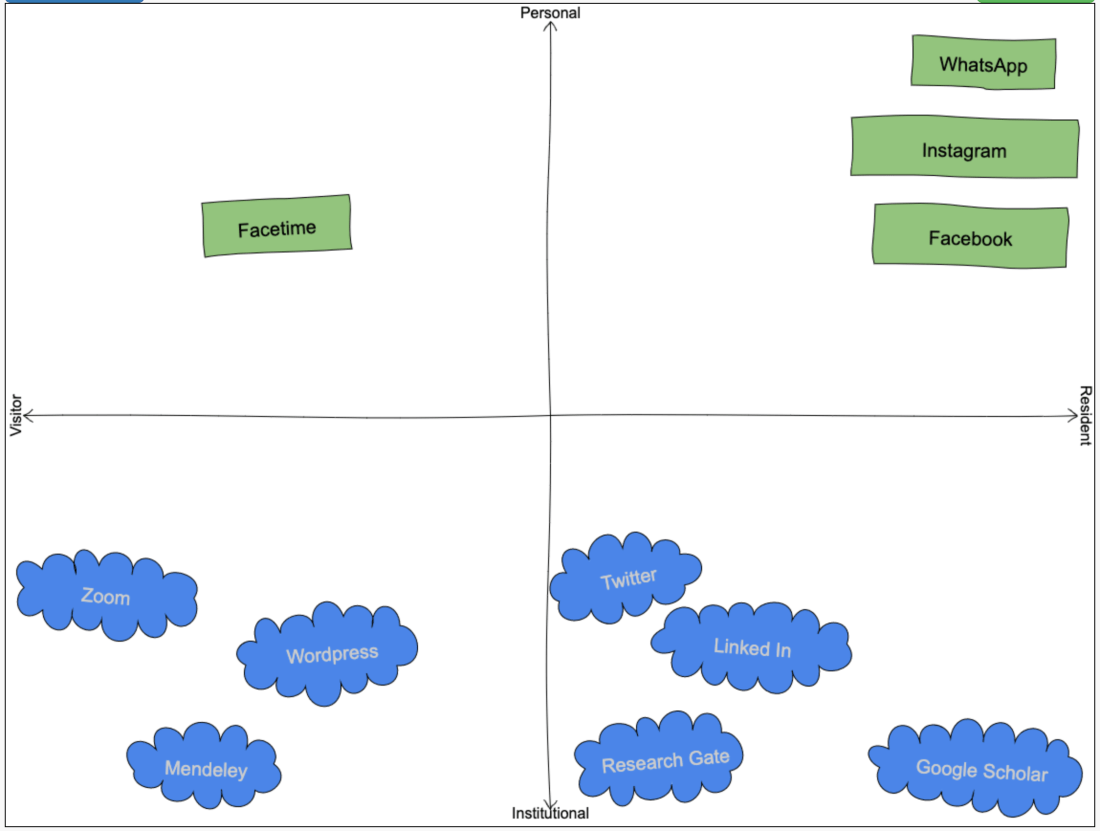
A useful tool for thinking about digital presence is the ‘Visitors and Residents‘ typology, proposed by White and LE Cornu (2009). The authors use a metaphor to think of the Internet as a place, where you interact with different tools, in which you may or may not share spaces with other people. The nature of these interactions define whether your presence in a particular digital place is as a visitor or as a resident.
Visitors see the web as a collection of tools to implement ideas created offline. They are users of these tools, not members. After their task is completed, the tool is abandoned.
Residents see the web as different places where they go to simply spend time, usually sharing this experience with other people. They belong to these places, they are members. Once they log off, there is still a digital footprint of their persona online.
These two extremes are considered to be in a continuum and we are expected to function as both Visitors and Residents across the virtual world.
The authors of this paper have developed an app as part of a research project that allows us to map our digital engagement in relation to being Visitors and Residents. For this app they also included an Y axis with a continuum between Personal and Professional use. Here is a video explaining how it works:
Below is my own mapping at the time of writing. As you can see, I like to keep my personal digital presence fairly separated from my professional one, although there is a little bit of overlap.
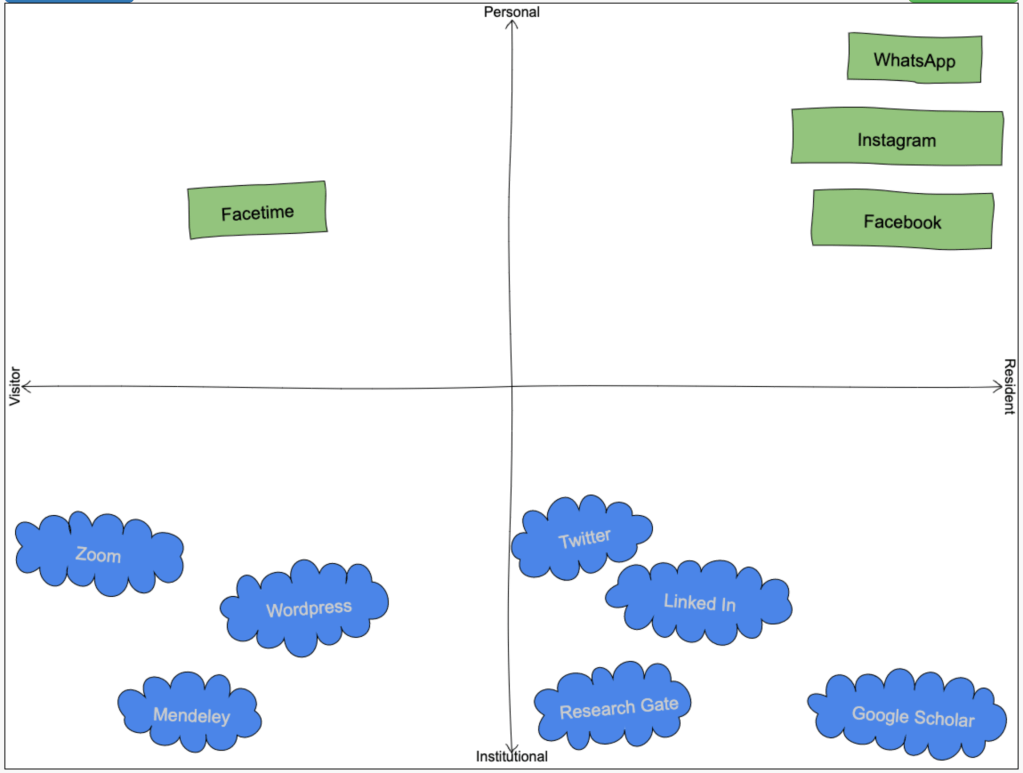
I think this can be a great tool in the online learning context for two reasons. First, it can help with our own digital literacy as teachers. From my own experience, if I’m not comfortable using a technology, I wouldn’t use it for teaching purposes. So this can be a great way to monitor our own progression through the use of different tools. Considering I’m now taking the “Facilitating Online Learning” subject that has encouraged me to start using (or re-activating) tools such as Twitter, WordPress and Flipboard, I’m curious to see which ones I’ll end up being more of a resident than a visitor over time.
Second, we can use it to better understand our students’ digital engagement. Their maps can be an opportunity to both discover new tools that we can use for educational purposes, and to identify gaps in students’ digital literacy relevant to their future workplace. This helps us to stay connected to our students and up-to-date with students’ needs (JISC Digital Insights, 2020).
References
JISC Digital Insights (2020). The student digital experience in 2020 https://digitalstudent.jiscinvolve.org/wp/outcomes/the-student-digital-experience-in-2020/
White, David S, & Le Cornu, Alison. (2011). Visitors and residents: A new typology for online engagement. First Monday, 16(9). https://doi.org/10.5210/fm.v16i9.3171
 Paula Galvão de Barba, PhD